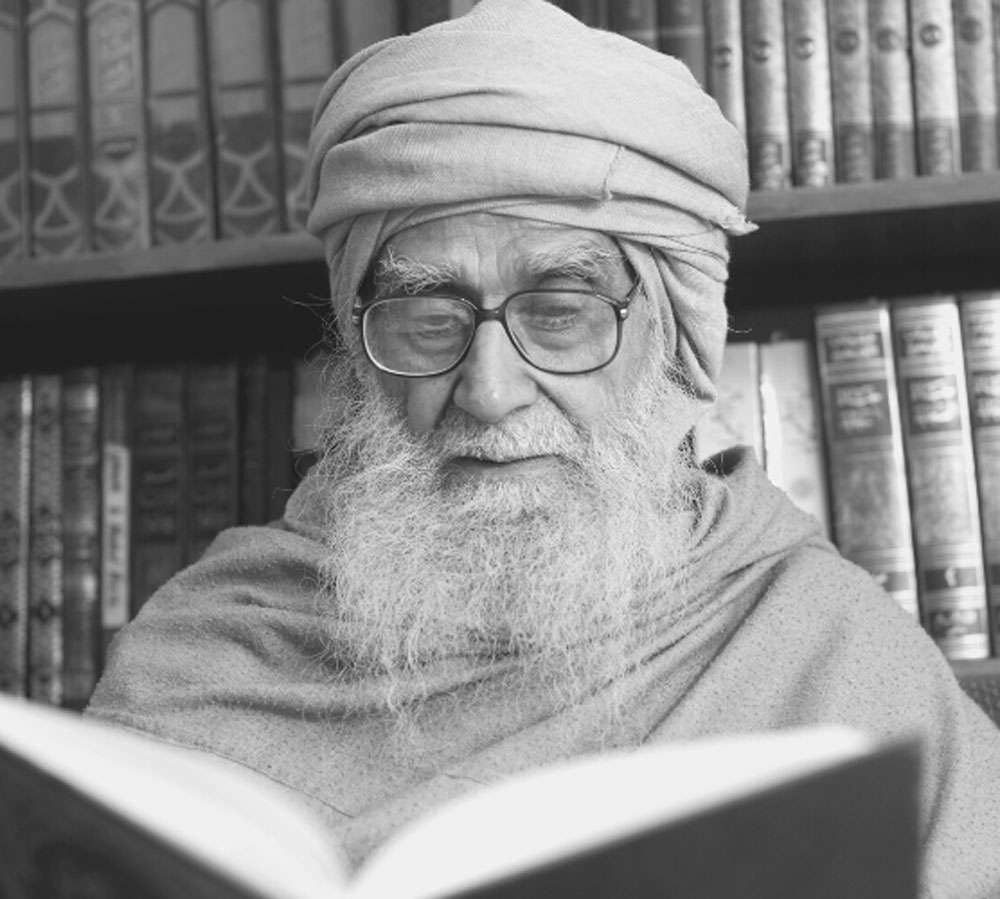
Farida Khanam
The third name closely associated with my mission is that of my daughter, Farida Khanam. She was born on May 2, 1952, in Azamgarh. Although she suffered from poor health from childhood, she pursued higher education with sustained determination. She completed her High School and Pre-University examinations privately from Aligarh Muslim University. She then earned her B.A. (English Honours) from Delhi College, New Delhi, followed by an M.A. in English Literature from Delhi University and another M.A. in Islamic Studies from Jamia Millia Islamia, Delhi. Later, she obtained her doctorate from the same university. She retired as a professor in the Department of Islamic Studies at Jamia Millia Islamia, Delhi.
Farida Khanam’s contribution to our mission has been so significant that it is difficult to express it adequately in words. In 1976, when I launched the monthly Al-Risala, she assumed responsibility for much of its work, in addition to translating articles from Urdu into English.
From that time onward, she devoted herself wholeheartedly to our mission. While my son, Saniyasnain Khan, effectively managed the administrative affairs and global expansion of the Al-Risala mission, Farida Khanam consistently supported its literary work. I shall mention only a few examples to illustrate the scope of her contributions, which were often made at considerable personal sacrifice.
Selfless cooperation in a mission is perhaps possible only for a woman. My book ‘Mazhab aur Jadid Challenge’ was first published in 1964 in Lucknow under the title ‘Ilm-e-Jadeed ka Challenge.’ It gained wide popularity and was translated into several languages. In Arabic, it was published as ‘Al-Islam Yatahadda.’
There was a repeated demand for an English translation. Several individuals attempted to translate it independently, but they were unable to complete the task. The main difficulty was that the book contained numerous quotations from English works, which had been rendered into Urdu. This posed no difficulty for translations into other languages, since the translators only had to render the Urdu text into their respective languages.
However, for the English translation, it was necessary to locate the original English quotations, as retranslating passages that had already been translated from English into Urdu back into English would have compromised accuracy.
Many English-educated individuals who wished to translate the book asked for the original English sources of the quotations. The difficulty, however, was that I no longer had access to the original books. I had written ‘Mazhab Aur Jadeed Challenge’ over a long period, during which I travelled extensively and consulted books in numerous libraries as well as in the private collections of scholars. By then, I could no longer recall which book had been consulted from which source. The situation seemed so difficult that I personally concluded that the book could never be translated into English.
Without any request from me, Farida Khanam took the initiative herself. She searched tirelessly, day and night, in various libraries, including Aligarh’s Azad Library, the Delhi Public Library, Delhi University Library, and others. She continued this effort for a long time until she successfully located most of the books and obtained all the original quotations with complete references.
Her initial involvement in this matter appears to have begun when Mr. Ikramuddin Ahmad (IAS) sent me a lengthy list. After studying my book ‘Religion and the Modern Challenge,’ he sent me a detailed multi-page list of all the referenced works, requesting that I provide those books. I was unable to supply them, but his list inspired Farida Khanam. Using that list, she began searching through various libraries. Ultimately, she succeeded in locating the English quotations and, by incorporating them, translated the book into English. This translation passed through several stages before it was finally published for the first time in Delhi in 1985 under the title ‘God Arises.’ The book comprises 288 pages. It is clearly a remarkable example of selfless cooperation.
The second incident I wish to mention occurred during a visit to Switzerland in July 2002. With the support of several Western countries, an international organization called the ‘Nuclear Disarmament Forum’ had been established. Under its leadership, a world conference was held in the historic Swiss city of Zug, attended by professors and highly educated individuals from various countries. I also participated in the conference at their invitation.
On the first day of the conference, its president, Andrey Bykov, announced that a document on international peace was needed. He explained that it would be published in several languages and distributed throughout the world.
To prepare this explanatory document, he divided the conference participants into three groups: one consisting of Russian scholars, another of scholars from Western countries, and a third of scholars from Asian countries. He asked each group to meet separately and prepare its own version. One of the three documents would then be selected and presented at the final session in Zug the following morning. Each group worked together to prepare its document and then submitted it to Andrey Bykov. However, he was not satisfied with any of the three versions.
At about ten o’clock on the night of July 29, I was alone in my room. I had finished the night prayer and was preparing to go to bed when Andrey Bykov came to my room unexpectedly. He looked deeply troubled. He said, ‘Each of the three groups has submitted its document to me, but I am not satisfied with any of them. I am deeply worried about what I will present before the participants in tomorrow morning’s session.’
He continued, “In my distress, I went to the church here and prayed. Finally, it came to my heart that only you could do this work. You can prepare the document I need.” He added, “I will meet you again in the morning. I am sure that by then you will have completed it.” I was astonished and could not even respond. He left me in that state and went out of my room.
My daughter, Farida Khanam, was also with me on that trip. She was staying in another room of the same hotel. I called her and asked her to come. When she arrived, I narrated to her the entire incident involving Andrey Bykov. I said, “When great international professors and English experts could not accomplish this task, how can I possibly do it? I feel utterly helpless in this matter.”
Farida Khanam’s response, however, was entirely different. She said, “We have the whole night before us. We will pray to God and remain awake throughout the night to prepare it.” After nearly an hour of her insistence, I finally agreed.
We then sat down together. First, we discussed the contents of the document, and gradually a clear outline began to emerge. Farida Khanam then began writing. I shared my thoughts, partly in English and partly in Urdu, while she continued to express them in English. This process took several hours, and by the time the dawn prayer began, a short essay of a few pages had been completed.
After that, we both offered the dawn (Fajr) prayer. Following morning tea, Farida Khanam went to the conference office and typed the three-page document on the computer. She then printed a few copies and immediately handed one to Andrey Bykov.
After reading the document, Andrey Bykov returned to my room. Unlike the previous day, he appeared very pleased. Holding a copy of the document, he said, “This is exactly the kind of document I wanted. I will now present it in today’s session, seek its approval, and then circulate it throughout the world. On the subject of peace, I have never come across a clearer document than this.”
This document later became part of my 136-page book ‘Ideology of Peace,’ published in 2003. It was this document that initially helped my ideas and efforts for world peace gain international recognition. Further developments followed, and on October 12, 2002, I received the International Award of Peace (Demiurgus Peace International Award) in Switzerland. The award was presented by former Russian President Mikhail Gorbachev. A detailed account of this occasion may be found in my travelogue, Safarnama Switzerland, published in the August 2003 issue of Al-Risala, my Urdu-language magazine. [An English translation, entitled My Journey to Switzerland, was later published as an 82-page book in 2022]. Farida Khanam’s selfless contribution in this regard illustrates the unique divine blessing with which a woman’s personality is endowed.
Farida Khanam’s role in my life also has a daily dimension: our discussions on intellectual and religious themes. These exchanges are not merely conversations; they have been an essential part of my intellectual growth. By God’s grace, I have never experienced mental stagnation; my intellectual development has continued steadily. One important factor in this ongoing progress has undoubtedly been my daily intellectual conversations with Farida Khanam. In this sense, I regard her as my intellectual assistant.
An example of this may also be found in the present book, ‘Woman: The Builder of Humanity.’ After completing the book, I wrote a short note at the end titled “Dedication.” In that note, I mentioned that Hagar, the mother of Ishmael, made a great sacrifice in ancient times, which led to a new era in human history. I added that there is now a need for another woman to arise and play the role of Hagar once again.
As was my practice, I showed this note to Farida Khanam. After reading it, she observed that it would not be appropriate to mention only one woman as the bearer of the great task of ushering in a new era. “It would be better,” she said, “to present it in general terms, so that every woman may consider herself addressed and feel that she, too, must play this role.” Accordingly, I revised the text in accordance with Farida Khanam’s suggestion.
Based on my experience, women are particularly well suited to meaningful intellectual discussion. Owing to their natural qualities, they can perform this role with remarkable effectiveness. The manner in which Farida Khanam remained connected with the Al-Risala mission over such a long period was no ordinary achievement. During this time, she faced exceptional challenges and extremely difficult circumstances; yet her dedication to the mission never wavered.
Through Farida Khanam’s example, I learned one of the most important qualities of a woman: unbreakable loyalty. If a person’s association with a cause is based only on logic, it will not last long. The truth is that, along with intellectual conviction, a deep emotional attachment to the cause is also necessary. It is this heartfelt bond that keeps a person’s commitment strong despite hardships or grievances.
Women are, by nature, more emotionally inclined, a trait generally less common among men. As a result, unless there is a strong opposing factor, women tend to form emotional attachments to causes and missions more readily. Such attachments enable them to remain consistently dedicated to the goal. This kind of selfless devotion is the strongest guarantee of a mission’s success.
Based on my understanding, every woman has the potential to develop the qualities I have seen in Farida Khanam. Every woman is inherently capable of such growth. However, it is also true that not every woman is able to realize this potential, and the responsibility for this rests largely with men. Men often see women merely as managers of the household and fail to recognize their innate capabilities. And what is not recognized cannot be properly developed or utilized.
For every man, a woman represents a valuable asset, but this value initially exists only in potential form. It is the man’s responsibility to recognize this potential and help women to transform a natural possibility into a lived reality.
In January 2001, I launched a special programme in Delhi called the Spiritual Class. Held weekly, the class aims to promote a positive understanding of spirituality and Islam. Most of its participants are highly educated young people. Before joining our class, they had developed a negative attitude towards Islam, shaped largely by their surroundings. To them, it seemed impossible that Islam could provide the answers they had been seeking for so long. However, after regularly attending our weekly class for several years, their thinking changed.
According to a Hadith, “Every child is born upon the nature; then his parents make him a Jew, a Christian, or a Magian.” (Sahih al-Bukhari, Hadith No. 1385)
This highlights the role of religious conditioning, which is the greatest obstacle to the spread of truth. Removing such conditioning through deconditioning is therefore the first step toward success in this effort. The present secular educational system, in effect, performs this process of deconditioning. Therefore, contrary to the common belief that modern education has distanced young people from religion, it has, in fact, brought them closer to true religion. This has created a new opportunity through modern education.
Availing of this opportunity is the first principle in planning the effort to call people towards God.
The Quran presents the concept of fitrah, or the natural order, by emphasizing that even in difficult circumstances there may be a hidden opportunity. It states:
“You may dislike something although it is good for you.” (Quran, 2:216)
This aspect of the modern educational system is an example of that very law of nature.
The women who attend our weekly Spiritual Class have now begun engaging in the work of introducing the peaceful, spiritual message of Islam within their own social circles. Whenever an opportunity arises, they share this message with others. Each of them carries pamphlets published by us in their bag. After a brief introduction, they offer these booklets to people to read.
Based on my experience, I can say that, compared to the average man, an educated woman may be more capable of carrying out this work.
In the early period of Islam, men made greater contributions than women. However, in view of present-day circumstances, I believe that in Islam’s second phase, women may make even greater contributions than men. It may well be that women are destined to play a central role in carrying the message of Islam forward and making it a powerful force for change. The course of history appears to point in this direction.