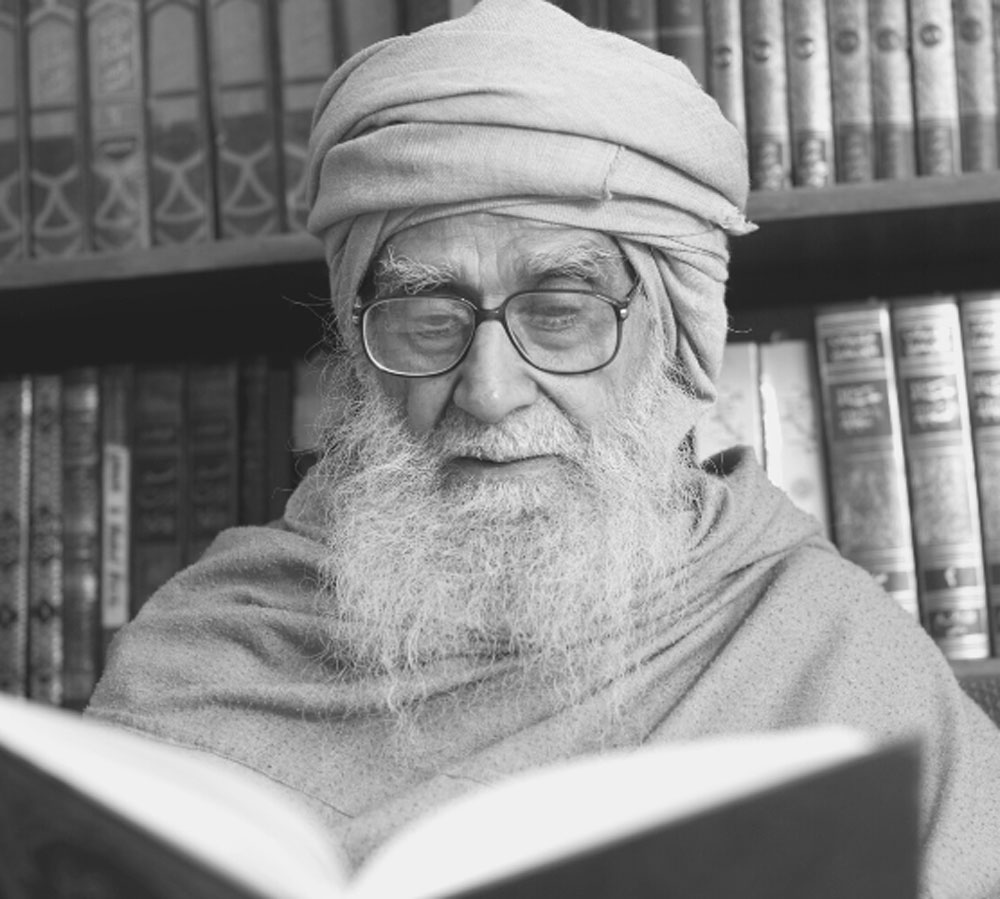
Professor Chandra Wickramasinghe is a Sri Lankan scientist, who heads the department of Applied Mathematics and Astronomy at University College, Cardiff, in Wales. He has been conducting research into the origin of life since 1962 in the company of an eminent English scientist, Professor Sir Fred Hoyle. The results of their research have been published in the form of a book entitled, Evolution from Space.
When the two scientists commenced their research they were both agreed on one point: that the notion of a Creator is inconsistent with science. But they were so shocked by the final result of their research that they had to revise their thinking. “From my earliest training as a scientist,” Wickramasinghe says, “I was very strongly brainwashed to believe that science cannot be consistent with any kind of deliberate creation. That notion has had to be very painfully shed. I am quite uncomfortable in the situation—the state of mind I now find myself in. But there is no logical way out of it.”
Both scientists made separate calculations into the mathematical chances of life having begun on earth spontaneously. Independently, they both arrived at the same conclusion: that the odds against life having ignited accidentally on earth were staggering in mathematical jargon 10 to the power of 40,000. Add 40,000 noughts to the figure I and you have the figure. “That number is such an imponderable in the universe that I am 100 percent certain that life could not have started spontaneously on Earth,” says Wickramasinghe.
As they write in their book: “Once we saw that the probability of life originating at random is so utterly miniscule as to make it absurd, it became sensible to think that the properties of physics on which life depends are in every respect deliberate.”
“Sir Frederick Hoyle was tending much more than I towards the higher intelligence Creator,” Wickramasinghe explains. “I used to argue against it, but I found myself losing every argument. At the moment I can’t find any rational argument to knock down the view which argues for conversion to God. If I could have found an argument—even a flimsy one—I would not have been a party to what we wrote in the book. We used to have open minds; now we realize that the only logical answer to life is creation, and not accidental shuffling. I still hope that one day I may go back to favour a purely mechanistic explanation—I say ‘hope,’ because I still cannot come to terms with my conversion.”
“My being a Buddhist—albeit not an ardent one—was never a problem, because it is an atheistic religion which does not profess to know anything about creation and does not have a creator built into it. But I now find myself driven to this position by logic. There is no other way in which we can understand the precise ordering of the chemicals of the universe except to invoke creation on a cosmic scale.”
Until recently, belief in God was considered to be just a personal creed, not backed up by rational thought. In recent decades, however, this situation has changed. New evidence has again and again come to light which makes belief in God a scientifically credible concept, rather than just a personally desirable creed.
Science impresses on man the abstract reality of God’s existence, but if there is a God, then what should man’s relationship with Him be? Science does not, and cannot, answer this question. This is a question that can only be answered by religion.
Basically every religion answers this question. But it is clear from the present state of religions that besides Islam—no other religion is preserved in its original form. Some religions are rendered false by their not having a concept of God. Some say that there are many gods, but science does not back up this belief; all branches of science and knowledge are agreed on the fact that, if there is a God, it must be one God, not several. Some religions have been pervaded by ideas which the human conscience can never accept—ideas like bias on the basis of colour and race.
Just as science brings one to belief in God, it also brings one to belief in Islam, for Islam is the only religion consistent with scientific facts. Science shows that the universe has a God; this fact in itself is enough to prove agnostic religions wrong. Study of the cosmos shows that it operates in unity and harmony; this shows that there must be one God, as Islam teaches, not many gods, as other religions claim. No religion, except Islam, presents a true concept of God. No religion tells man what his relationship with God should be.