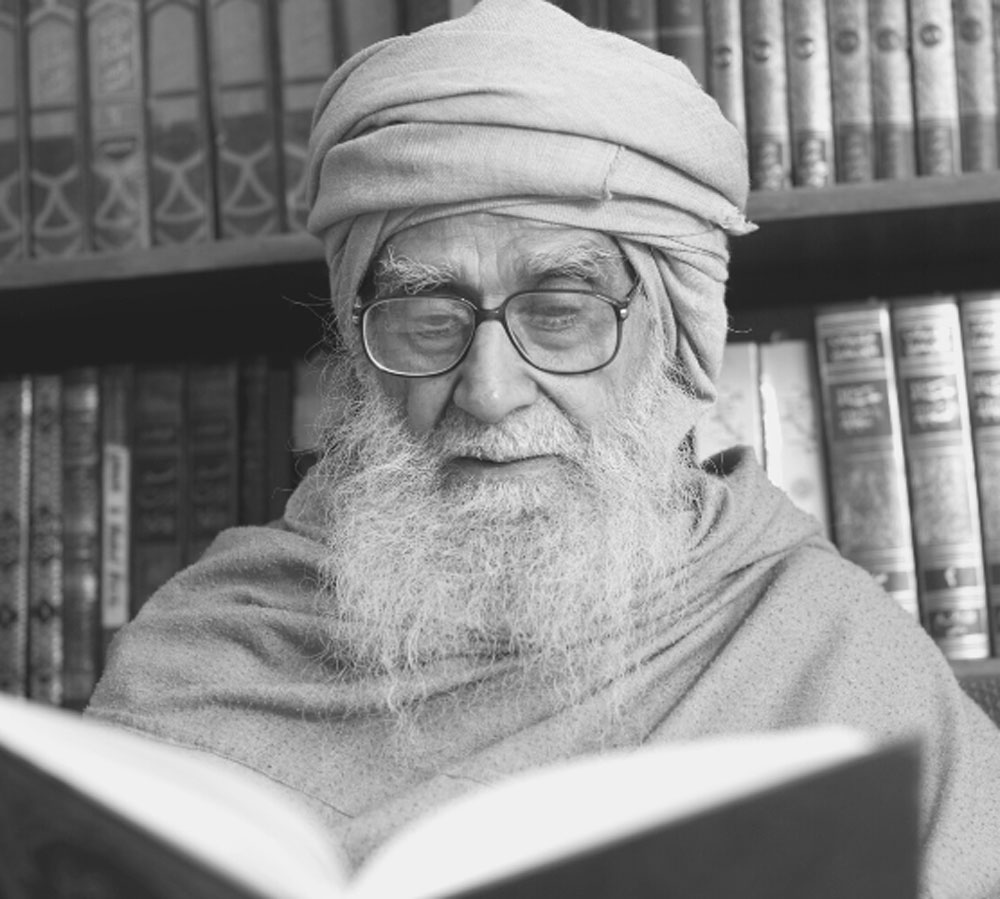
A Press Conference given by Maulana Wahiduddin Khan, President of the Islamic Centre, Delhi, in Hyderabad, South India, on November 12, 1982.
Our meeting today is not a press conference in the normal sense of the term. Press conferences usually discuss public issues and, as you know, we have no such issue before us. This is really a sort of journalistic meeting.
As part of the Islamic Centre’s programme for constructive work, we seek to communicate our message to every section of the community. So our colleagues thought it would be a good idea for it to be communicated to our friends of the press as well. For the press is, in our day and age, like the public’s eye, with which they see; it is like the public’s mind with which they think.
Although journalism is not very advanced in our country, still—in theory at least—the press is the greatest power in the modern age. In western countries the press has become an independent force, parallel to governments. If the press in these countries turns against a president or prime minister, then its opposition cannot be ignored. The political eclipse of Richard Nixon in 1973 provides us with example of the power of the press in Western countries.
But, if you will permit me, I would like to say that the power of the press has not yet been channelled in the right direction. Man today holds this power in his grasp, but as yet it has not been effectively implemented for the improvement of the mankind. I will clarify this point with one example:
Imagine that the plane I came from Delhi on belonged to Israel or America, and I hijacked it and made it land in Hyderabad. Then, if any press conference was announced, it would be much bigger one than that which has now come together. Correspondents of foreign newspapers would have rushed from Delhi to Hyderabad so that they could cover it; despite the fact that, we all know, there is nothing more futile than hijacking an aeroplane. But this is what journalism in our day is all about. That which is totally unimportant in the world of reality assumes the highest importance in the world of journalism. Why? Simply because it contains what in journalistic jargon is called news value.
During a recent journey I stopped over for a while in the Ugandan airport of Antebbe. On seeing it, I recalled that this was the place where the Israeli airliner, hijacked by Palestinians in 1976, landed. For a few days this story remained on the front page of newspapers; but you all know the price that the Palestinians had to pay for this afterwards.
From this one can tell how modern journalism makes a thing, which in real terms is absolutely worthless, appear as if it is of the greatest worth.
What we ask of the press is that it should attach importance to real value, not to news value. Attaching importance to real value makes one realistic, and realism is the source of all human virtues. Attaching importance to news value, on the other hand, leads to insincerity, and insincerity is, without doubt, the cause of all human evils.
The press can play an important role in the sincere and constructive society that Islam seeks to create. But at present it is proceeding in a direction quite contrary to this aim. Islam seeks to train people to attach importance to realities, and in modern journalism perfection has become to spotlight what is most unreal.
While on a foreign trip, I once met a gentleman from Canada. He asked me the meaning of Islam. “Islam means realism,” I replied. In actual fact, Islam is the science of life, and this science is founded on the principle that one should be realist in this world; in every matter one should adopt a realistic attitude which is the secret to every success in life, and lack of realism is the prime cause of all failure.
In the present age there are two departments which are particularly important in fashioning the shape of life. These two departments are science and journalism. Science is connected more to the physical world and journalism to the human world; science studies events in the universe, and journalism deals with the events in the world of man. But the strange thing is that these two departments are at severe odds with one another.
Science is founded fully on realistic principles; it proceeds in compliance with the reality that there is a world outside us that rests solidly on firm laws. Water, for instance, has a law of its own; so does land, and so does the atmosphere. Ships come into being by virtue of conformance with the laws of water; motor cars result from conformance with the laws of land; aeroplane develop from the conformance with laws of atmosphere. This complete conformance with the outside world is what every triumph of science basically is.
But in journalism—or the world of man—the very opposite is the case. One chapter of a book I read on journalism showed the principles that a journalist observes’ when compiling a story. These principles have been illustrated by a special term in journalism: inverted pyramid. For instance, a building, 21-storeys in height, is being constructed in town. When a journalist makes a story out of this, his first sentence will be: ‘21-storey building constructed.’ Clearly, the 21st storey was the last thing to be built. First the plan was laid; then the ground was prepared; then the foundations were dug, and construction started from the base, until finally the top storey was erected. But, in the news story, it is the twenty-first storey that comes first.
One can say that if science attaches importance to real value, then journalism attaches importance to news value. This contradiction in the two major departments of life has caused chaos on earth. The principles which we adopt in science with successful results, we fail to adopt in the rest of our lives; there, we put the contrary principles into practice. The result of this contradiction is that the success which we have obtained in science, we have not been able to obtain in ordinary life. We can, by scientific means, construct a superbly planned town, but in this same town we cannot live superbly planned lives. Science has enabled us to manufacture machines which work with technical perfection, but we cannot make man fulfill his duty with the same technical perfection.
The thing which is flashed most in the newspapers is that which has the most news value. The most successful press conference is one which is convened on some major public issue. We would like this situation be changed. We would like to see the same realistic posture that is adopted in the world of physics, adopted in the world of man also.
Islam holds that Quran is God’s light to man, guiding him on the path to this life of realism. The summary of its teachings is that man should adopt the religion that the whole universe has adopted:
Are they seeking a religion other than God’s, when every soul in heaven and earth has submitted to Him, willingly or by compulsion? (Quran, 3:83)
The relation between the Quran and the universe is the same as that between theory and demonstration in science. The Quran is the theory of what the universe follows on a practical level.
The Quran tells us of the existence of God, and the universe, with its superb design, confirms the truth of this. The Quran, further, tells man to bow before the Lord, just as the trees cast their shadows on the ground, prostrating themselves before God in all humility.