By Mushtaq Ul Haq Ahmad Sikander, New Age Islam
16 October 2026
Beyond Tradition: Maulana Wahiduddin Khan’s Vision for Madrasa Reform, Intellectual Renewal and Peaceful Engagement with the Modern World
Main Points:
- It intends at transforming institutional culture to encourage questioning, independent reasoning and wisdom rather than rote learning, conformity and sectarian loyalty.
- It equips religious scholars with English, scientific literacy, digital skills and an understanding of contemporary society.
- It presents Islam through reasoned communication, interfaith dialogue and constructive engagement rather than confrontation.
- It emphasizes humility, self-examination, women’s education and the development of scholars who combine religious learning with service to humanity.
- It recognises the book’s reformist contribution while examining its repetition, organisational weaknesses, omissions and the practical limits of its conciliatory approach.
….
Ulema Aur Deeni Madaris: Daurr Jadeed Kye Challenges aur Imkanaat
Author: Maulana Wahiduddin Khan
Compiled by: Dr Farida Khanam, Maulana Farhad Ahmad and Maulana Syed Iqbal Ahmed Umari
Publisher: Goodword Books, Noida, India
Year of Publication: 2026
Pages:392
Price: Not mentioned
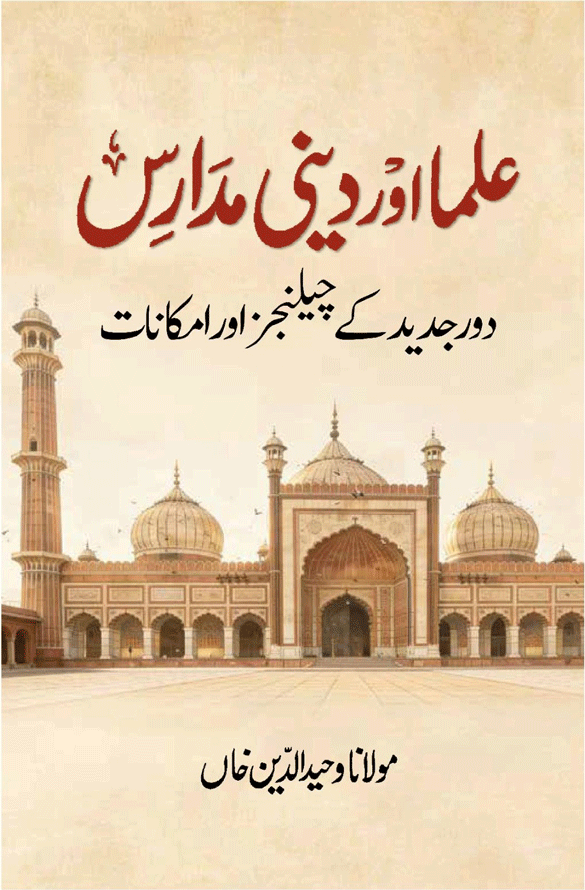
Maulana Wahiduddin Khan’s Ulema Aur Deeni Madaris: Daurr Jadeed Kye Challenges aur Imkanaat is not merely a book about madrasas. It is a sustained, often uncomfortable, interrogation of the intellectual and spiritual condition of the Muslim religious establishment in the modern age. Compiled from the Maulana’s writings, speeches, travelogues, interviews and question-and-answer sessions, the volume gathers his reflections on ulema, religious seminaries, dawah, modern knowledge, communal coexistence, sectarianism, women, English education, science and the urgent need for Muslims to understand the age in which they live.
The book’s central argument is simple but demanding: madrasas possess immense potential, yet much of it remains unrealised because they often cultivate imitation, sectarian loyalty and fear of new ideas rather than intellectual courage, wisdom and openness. Maulana Wahiduddin Khan does not dismiss madrasas. On the contrary, he recognises their historical role, their moral seriousness and the extraordinary learning potential of their students. But he insists that a madrasa which produces graduates unable to understand modern society, communicate with educated people, engage with science or address the questions of contemporary youth has failed to fulfil the larger purpose of Islamic education.
The book is therefore both appreciative and critical. It honours the ulema as inheritors of a great scholarly tradition, while asking them to recover the original spirit of that tradition: inquiry, humility, intellectual breadth, moral seriousness and concern for humanity. It is a book written not by an enemy of the madrasa, but by a deeply concerned well-wisher who believes that Muslim institutions can become centres of renewal if they are willing to reform their environment, broaden their horizons and reconnect with the living realities of the world.
The Author and His Intellectual World
What distinguishes Maulana Wahiduddin Khan from many other religious thinkers is that he did not treat modernity merely as an enemy to be denounced. He saw it as a reality to be understood, and in many respects as an opportunity to be used. For him, the printing press, universities, media, English language, science and modern communication were not threats in themselves; they were instruments that could serve the higher cause of knowledge, dawah and human welfare. This outlook shapes every page of Ulema Aur Deeni Madaris.
The present book, compiled by Dr Farida Khanam, Maulana Farhad Ahmad and Maulana Syed Iqbal Ahmed Umari, brings together material that otherwise remains scattered across the Maulana’s vast corpus. Its strength lies in this compilation: the reader encounters not one formal treatise but a living conversation, lectures, travel impressions, interviews, answers to questions and reflections composed over decades. The result is a book that feels less like an academic monograph and more like an extended dialogue between a concerned scholar and the future of Muslim religious education.
Islamic Culture as the Culture of Iqra
The book’s deepest intellectual foundation lies in the Quranic command Iqra—“Read.” For Maulana Wahiduddin Khan, Islamic culture is fundamentally a culture of Iqra: a culture of reading, reflection, observation, learning and intellectual awakening. Islam did not begin by asking believers to defend inherited opinions. It began by inviting them to read, think, observe the signs of nature and recognise the signs of God in the universe.
This understanding has profound implications for madrasas. If Islamic culture is a culture of Iqra, then a madrasa cannot be merely a place where students memorise texts, repeat inherited positions and defend sectarian identities. It must become a place where the mind is trained to question responsibly, where curiosity is not treated as rebellion, and where knowledge is pursued with humility and sincerity.
Maulana Khan distinguishes between two aspects of knowledge: information and wisdom. Information is the accumulation of facts, wisdom is the ability to understand their meaning, apply them rightly and act with moral clarity. His complaint against much contemporary religious education is that it often produces people who possess information but lack wisdom. Such people may be able to quote texts, issue verdicts and defend positions, yet remain unable to understand the complexities of the age or respond to them creatively.
This is a devastating but necessary criticism. The modern world is saturated with information. The internet, social media, television, mobile phones and endless streams of content have made facts easily available. But wisdom has not increased proportionately. Indeed, the Maulana suggests that people may become intellectually dwarfed not because they lack access to knowledge, but because they are distracted, superficial and unable to think deeply. In such an age, the madrasa’s task is not simply to add more information to the student’s mind, it is to cultivate wisdom, discipline, reflection and moral purpose.
The Crisis of Intellectual Dwarfism
One of the most striking ideas in the book is Maulana Wahiduddin Khan’s diagnosis of what may be called intellectual dwarfism. By this he means the shrinking of the human mind through distraction, arrogance, blind imitation and the refusal to engage with unfamiliar ideas. A person may be outwardly learned, yet inwardly narrow. He may possess religious vocabulary, but lack the capacity to understand the world.
The Maulana’s criticism is directed not only at madrasa students but at Muslims in general. He argues that many Muslims have become reactive rather than reflective. Instead of studying a new idea, they condemn it. Instead of understanding modern thought, they dismiss it. Instead of asking what an invention or social change means, they issue a fatwa against it. This habit, he believes, has impoverished Muslim intellectual life.
The danger is especially serious for the ulema. A religious scholar who does not understand his times cannot guide his community through them. He may speak with authority, but his authority becomes detached from reality. He may preserve old formulations, but fail to address new questions. The result is a growing gap between religious leadership and educated youth, between the language of the madrasa and the language of the modern world.
Maulana Khan repeatedly returns to the question, Do the ulema know their age? This is perhaps the book’s central question. A scholar may know classical texts, jurisprudence, hadith and theology, yet remain ignorant of the social, scientific, political and psychological realities of his own time. Such a scholar may be respected within his circle, but he cannot meaningfully guide society. For Maulana Wahiduddin Khan, knowledge of one’s age is not optional, it is a religious and intellectual necessity.
Madrasas: Potential and Limitations
The book treats madrasas with a rare balance. Maulana Wahiduddin Khan does not join those who see madrasas only as backward institutions or breeding grounds of extremism. He firmly rejects the propaganda that madrasas teach violence or provide arms training. He recognises that such allegations are often exaggerated, politically motivated or based on ignorance. Madrasas, in his view, are religious institutions with a long history of service to Islam, preservation of learning and moral formation.
At the same time, he refuses to romanticise them. He acknowledges that many madrasas suffer from serious limitations: narrow curricula, sectarian orientations, fear of criticism, lack of exposure to modern knowledge, poor language training and an environment that does not encourage independent thought. These weaknesses prevent madrasas from producing the kind of scholars the age requires.
One of the book’s important arguments is that reform in the environment of madrasas is more important than mere curriculum reform. This is a subtle and profound point. A curriculum can be updated by adding English, computer studies or modern subjects, but if the environment remains closed, authoritarian and fearful, students will not become open-minded. They may learn new tools, but they will continue to think in old, defensive ways.
For Maulana Khan, the madrasa environment must nurture doubt in the constructive sense: the willingness to ask questions, examine assumptions and seek truth. He observes that madrasas often make things sacred in a way that discourages questioning. Certain opinions, personalities, institutions and interpretations become untouchable. This creates stagnation. The student learns reverence, but not inquiry, obedience, but not intellectual courage.
The Maulana does not advocate disrespect for tradition. Rather, he argues that genuine respect for tradition requires engaging with it critically and creatively. The great scholars of Islam were not mere repeaters of inherited views; they were thinkers who responded to the questions of their age. A madrasa that produces only imitators cannot produce mujtahids, reformers or original minds.
Why Madrasas Do Not Produce Mujtahids
A recurring concern in the book is the absence of mujtahids from contemporary madrasas. Maulana Wahiduddin Khan asks why Muslim madrasas, despite their large numbers and long history, have not produced great independent thinkers in the modern period. His answer is uncomfortable: because they do not accept criticism.
In many madrasas, criticism is treated as disrespect. A student who questions a teacher, challenges a prevailing opinion or expresses an unfamiliar idea may be seen as arrogant or misguided. This culture suppresses intellectual initiative. The student learns that safety lies in conformity. Over time, the institution produces graduates who can preserve the system but not renew it.
Maulana Khan’s point is not that every student should become a mujtahid, nor that tradition should be abandoned. Rather, he argues that the capacity for independent reasoning must be allowed to grow. The madrasa should be a place where a brilliant student is encouraged to read widely, think deeply and express his ideas. Without such freedom, talent remains buried.
He also links this problem to sectarianism. Many madrasas are not primarily institutions of universal Islamic learning but they are institutions of sectarian identity. Their purpose becomes the defence of a particular school, group or interpretation. Education for sect replaces education for truth. This is a major reason, in his view, why madrasas fail to attract and produce great minds.
By contrast, colleges and universities, despite their own flaws, often operate on the principle of education for education. They may not be perfect, but they are less bound by sectarian loyalty. The madrasa must recover this larger purpose, education as a means of intellectual and spiritual development, not merely as a means of strengthening a sect.
Sectarianism and the Narrowing of Religious Vision
The book is particularly severe on sectarianism. Maulana Wahiduddin Khan believes that sectarian goals have distorted the purpose of religious education. Instead of producing scholars who serve Islam and humanity, many madrasas produce defenders of sects. The student is trained to see other Muslims not as fellow believers with differences of interpretation, but as opponents to be refuted.
This sectarian mentality has multiple consequences. It divides the community, wastes intellectual energy, encourages polemics instead of scholarship and prevents cooperation on larger issues. It also narrows the vision of the ulema. A scholar who sees Islam through sectarian spectacles cannot understand the universality of the Quranic message.
Maulana Khan calls for madrasas to embrace openness while overcoming the clout of sects. This does not mean erasing differences or pretending that all interpretations are equal. It means refusing to make sectarian identity the centre of religious life. The madrasa should teach students to distinguish between essential faith and secondary differences, between principles and polemics, between the service of Islam and the service of a group.
This message is especially relevant in South Asia, where religious education is often organised along sectarian lines. The book’s insistence on unity, coexistence and intellectual openness is therefore not abstract idealism. It is a practical necessity for Muslim communities divided by school, institution and ideology.
Dawah as Fard-e-Ain
Perhaps the most persistent theme in the book is dawah. For Maulana Wahiduddin Khan, dawah is not merely an activity of preachers, missionaries or specialised organisations. It is fard-e-ain—an obligation upon every Muslim, not merely fard-e-kifaya, a collective duty discharged if some people perform it.
This is a radical reorientation of Muslim religious responsibility. If dawah is the duty of every believer, then every Muslim must become, in some measure, a communicator of Islam. This requires knowledge, good character, patience, wisdom and the ability to speak to people in their own language. It also requires an understanding of the audience, their questions, anxieties, intellectual assumptions and cultural context.
Maulana Khan’s emphasis on dawah explains his insistence on English, modern knowledge and communication skills. A Muslim who cannot speak to an educated non-Muslim, or who cannot present Islam in reasonable and contemporary language, cannot fulfil this duty effectively. Dawah is not shouting slogans or issuing condemnations, it is intelligent, compassionate communication.
The book contrasts the passion and organisational zeal of Christian missionaries with the relative weakness of Muslim dawah efforts. Maulana Khan does not praise missionaries for their theology, he admires their dedication, discipline and commitment to reaching people. He asks why Muslims, who possess a universal message, often lack comparable seriousness in communicating it.
For him, the problem is not lack of resources but lack of vision. Muslims often prefer confrontation with governments, symbolic battles and reactive politics over the patient work of education, dialogue and persuasion. He sees this as a tragic misallocation of energy. The real opportunity of the age lies not in tussle but in dawah, service and intellectual presentation.
Knowing Our Times
The phrase “knowing our times” functions almost as a refrain throughout the book. Maulana Wahiduddin Khan believes that the greatest failure of the ulema is epistemological. They do not understand the nature of modern knowledge, modern culture and modern society. They may know fiqh, hadith and theology, but they do not understand the intellectual world in which their audience lives.
This epistemological failure has serious consequences. The ulema may condemn new inventions as innovations, misunderstand scientific theories, misread Western culture or issue fatwas that appear irrelevant to educated Muslims. They may treat every modern development as a threat, rather than asking whether it can be understood, used or responded to creatively.
Maulana Khan does not claim that everything modern is good. He is clear that crony capitalism, unjust wars, materialism and moral decay are contrary to Islamic values. But he distinguishes between modern tools and modern abuses. The internet, English, science, technology and universities are not inherently anti-Islamic. They become harmful only when used without ethical direction.
His argument is that Muslims must develop discernment. They must be able to separate the reality of the age from its distortions. They must not react blindly to every new thought, nor accept everything uncritically. They must study, reflect and respond with wisdom. This is where the book speaks powerfully to the present moment. In an age of artificial intelligence, digital media, global communication and rapid social change, the need to understand one’s times has become even more urgent. A religious leadership that cannot interpret technology, economy, psychology or global politics will lose the trust of educated generations.
English, Science and the Language of the Age
Maulana Wahiduddin Khan’s advocacy of English is one of the book’s most practical messages. He learnt English himself and repeatedly advised madrasa students to do the same. For him, English is not a symbol of Westernisation. It is a tool of communication, knowledge and dawah. The Maulana argues that madrasas must become environments for learning languages. Just as traditional madrasas cultivated Arabic, they must now cultivate English and other modern languages. A student who knows Arabic but not English is limited in his ability to access modern knowledge and communicate with a global audience. A student who knows both can become a bridge between two intellectual worlds.
He extends this argument to computer skills and modern scientific literacy. In the contemporary world, a religious scholar who cannot use technology, understand basic science or communicate through modern media is handicapped. He may have deep knowledge of the past, but he cannot effectively serve the present.
The book also criticises the inability of many Muslim writers to write in a modern, scientific and reasonable style. Religious literature, according to Maulana Khan, often fails to appeal to modern youth because it is emotional, repetitive or polemical rather than rational, clear and relevant. The language of dawah must be the language of reason, evidence and human concern. This is not a call to dilute Islam. It is a call to present Islam in its full intellectual dignity. The Quran itself appeals to observation, reflection and reason. A religious discourse that abandons reason betrays its own sources.
Islam and Science
Maulana Wahiduddin Khan repeatedly argues that Islamic teachings help in advancing science. For him, the Quranic invitation to reflect on nature, the emphasis on observation and the condemnation of blind imitation create an intellectual climate favourable to scientific inquiry. Islam, properly understood, does not fear science, it seeks to direct science toward truth, humility and ethical responsibility.
His criticism of the ulema’s attitude toward science is therefore not a call for superficial apologetics, finding scientific miracles in every verse, but for a deeper engagement with the scientific worldview. Muslims must understand how science thinks, what its methods are, and where its limits lie. They must also recognise that science answers questions of mechanism, while religion addresses meaning, purpose and morality.
The book suggests that the Muslim world’s scientific backwardness is not due to Islam, but to the failure of Muslim institutions to cultivate the spirit of inquiry. Madrasas, if reformed, could become centres where religious and scientific learning coexist. But this requires an environment of openness, not fear.
Jihad, Priorities and the Politics of Reaction
One of the most controversial aspects of Maulana Wahiduddin Khan’s thought is his understanding of jihad. The book reflects his consistent position that Muslims have misunderstood their priorities. Instead of concentrating on education, dawah, character-building and constructive work, many Muslims have become obsessed with confrontation, rebellion and political power.
He argues that the modern age does not justify rebellion or armed struggle in the name of Islam. The real jihad, in his view, is the struggle to spread the message of Islam peacefully, to reform oneself, to serve humanity and to use available opportunities for constructive purposes. Violence, in his view, closes doors, patience and peaceful struggle opens them. This position is closely connected to his broader philosophy of peace. Maulana Khan believed that peace is not passivity. It is an active discipline requiring patience, self-control and strategic wisdom. Patience does not mean surrender, it means refusing to be provoked into destructive action. It means preserving one’s energy for meaningful work rather than wasting it in futile conflict.
The book’s treatment of India is especially significant. Maulana Khan argues that India is not Darul Harb. This argument reflects his broader insistence that Muslims should accept the political framework in which they live and work constructively within it. For him, the politics of permanent confrontation impoverishes the community. It consumes attention, resources and moral energy that could be used for education, economic development, dawah and social service. The Maulana’s alternative is not political quietism in the sense of indifference, it is constructive engagement guided by wisdom and long-term vision.
Communal Harmony and Coexistence
The book also addresses communal issues in India. Maulana Wahiduddin Khan believes that communal problems cannot be solved through confrontation, hatred or the desire to defeat the other community. They require patience, humility and a willingness to build relationships.
His suggestion that Muslims should behave like the “smaller brother” in communal situations may appear controversial, but it reflects his strategic and ethical outlook. He believes that humility, restraint and goodwill can disarm hostility. If one community refuses to respond to provocation with provocation, it creates the possibility of a better relationship. This is not a call for submission or injustice. It is a call for wisdom. The Maulana understands that communal violence destroys both communities, but especially damages the weaker one. Therefore, the wiser course is to avoid confrontation, protect life and dignity, and work patiently for mutual understanding.
He also advocates tolerance rather than the fantasy that all religions should become one. For him, religious diversity is a reality. The task is not to erase differences but to develop respect, dialogue and peaceful coexistence. This position is consistent with his lifelong commitment to interfaith understanding and nonviolence.
Women as the First Respondents
A particularly important theme in the book is the role of women. Maulana Wahiduddin Khan describes women as the first respondents and essential to the progress of any nation. This is not a merely rhetorical tribute, it reflects his belief that no society can advance while neglecting the intellectual and moral development of half its population.
For the Maulana, women are not merely recipients of religious instruction, they are carriers of values, educators of children and participants in the intellectual and spiritual life of the community. A madrasa or Muslim institution that ignores women’s education limits its own future.
This theme has special relevance in the context of Muslim educational institutions. If madrasas are to become centres of renewal, they must think seriously about women’s access to knowledge, their intellectual formation and their role in family and community life. The book’s emphasis on women as first respondents suggests that reform must begin not only in the classroom but also in the home.
Travelogues, Interviews and the Living Voice of the Maulana
One of the distinctive features of Ulema Aur Deeni Madaris is its inclusion of travelogues and interviews. These sections give the book a personal, almost conversational quality. We see Maulana Wahiduddin Khan not only as a writer of treatises but as a traveller, observer, teacher and interlocutor.
During his travels, he visited madrasas, met students and teachers, and observed how Al-Risala was read in different places. These encounters gave him direct knowledge of the strengths and weaknesses of Muslim institutions. They also reinforced his belief that madrasa students possess great learning potential, provided they are encouraged and given the right environment.
The interviews and question-and-answer sessions are especially valuable because they show the Maulana responding to real concerns. Questions about madrasas, modern education, English, dawah, communal relations and the future of the ulema are answered with characteristic directness. The reader sees a mind that is not defensive but exploratory; not rigid but principled.
The Need for a New Religious Intellectual
The book ultimately calls for a new kind of religious intellectual: a scholar who is deeply rooted in Islamic tradition but also conversant with the modern world. Such a scholar would know Arabic and English; theology and science; fiqh and history; spirituality and social reality. He would be humble, not arrogant; curious, not fearful; constructive, not reactive.
Maulana Shibli Nomani is invoked in the book as an example of such a scholar. Though a traditional scholar, Shibli understood his times and presented Islam in a manner relevant to his age. He combined classical learning with historical consciousness, literary sensibility and intellectual breadth. Maulana Wahiduddin Khan sees in him a model for contemporary ulema. The challenge is enormous. The modern religious scholar must not only master traditional disciplines but also understand economics, politics, psychology, media, technology and global affairs. He must be able to write, speak and communicate in ways that appeal to educated youth. He must be able to distinguish between the eternal principles of Islam and the changing forms of their application. This is why Maulana Khan insists that madrasas must not professionalise religion. If religious knowledge becomes merely a profession, something done for salary, status or institutional power it loses its spiritual vitality. The true scholar is motivated by love of God, concern for humanity and desire for truth, not by careerism.
Purification of Mind and Soul
Beneath all the book’s institutional and educational arguments lies a spiritual concern, the purification of mind and soul. Maulana Wahiduddin Khan believes that external reform is meaningless without inner transformation. A madrasa can add subjects, build libraries and introduce computers, but if the hearts of its students remain filled with hatred, arrogance, fear or worldly ambition, it will not produce true scholars.
Purification requires humility, sincerity, patience and love of God. It requires the willingness to examine oneself before condemning others. It requires the ability to listen, learn and grow. In this sense, the book is not only a critique of madrasas, it is a mirror held up to every Muslim who claims religious knowledge. The Maulana’s spirituality is not escapist. It does not withdraw from the world, it engages the world with a purified heart. The scholar who has purified his soul can face modernity without panic, engage criticism without anger and serve humanity without desire for power.
Limitations of the Book
Despite its many strengths, the book has limitations. As a compilation, it inevitably contains repetition. The same themes, dawah, English, knowing the times, sectarianism, openness, appear in different forms across chapters. Some readers may find this repetitive, others may see it as reinforcement of central ideas.
The book would also have benefited from a more systematic arrangement. Since it draws from writings, speeches, travelogues and interviews, the reader sometimes moves between genres without a clear structural progression. A more detailed editorial introduction, chapter summaries and contextual notes would have helped readers unfamiliar with Maulana Wahiduddin Khan’s broader corpus.
The absence of the Al-Risala September 2000 madrasa number is a notable omission. That issue would have provided a focused and comprehensive treatment of madrasas, making the book more complete. Its exclusion means that the present volume, despite its richness, does not fully represent the Maulana’s thinking on the subject.
Finally, some readers may question whether Maulana Khan’s optimism about dialogue, English education and peaceful engagement is sufficient in a context marked by communal polarisation, state suspicion and social hostility. His emphasis on patience and constructive work is morally compelling, but it may appear insufficient to those who feel themselves under direct threat. Yet this tension is precisely what makes the book valuable, it forces readers to confront the difference between reactive politics and long-term wisdom.
A Book for the Present Moment
Ulema Aur Deeni Madaris arrives at a moment when questions about religious education, modernity, communal harmony and Muslim identity are more urgent than ever. Across South Asia, madrasas are being scrutinised, politicised and misunderstood. At the same time, Muslim communities face the challenge of producing a generation that is religiously grounded, intellectually confident and socially responsible.
Maulana Wahiduddin Khan’s answer is neither defensive nostalgia nor uncritical modernisation. It is renewal through understanding. The madrasa must return to the spirit of Iqra; the ulema must know their times; the student must be trained in wisdom as well as information; the community must prioritise dawah, education and constructive engagement over confrontation. The book’s message is especially important for educators, administrators, madrasa teachers, students and policymakers. It reminds us that educational reform is not merely a matter of syllabi and infrastructure. It is a matter of culture, environment, intention and vision. An institution becomes great not by adding subjects, but by cultivating minds capable of truth, compassion and creativity.
For Muslim communities, the book is a challenge. It asks whether we are producing scholars who can speak to the age, or merely guardians of inherited formulas. It asks whether our institutions nurture inquiry or fear, unity or sectarianism, wisdom or information. It asks whether we see the modern world as an enemy to be condemned or as a field of opportunity to be understood. For non-Muslim readers, the book offers an insight into a significant strand of Muslim thought: one that rejects violence, values dialogue, embraces learning and seeks peaceful coexistence. It shows that the critique of madrasas need not come from outside the tradition; it can emerge from within it, from a scholar deeply committed to Islam and its intellectual renewal.
Conclusion
Ulema Aur Deeni Madaris: Daurr Jadeed Kye Challenges aur Imkanaat is a timely, courageous and necessary book. It is not comfortable reading for those who wish to defend every existing practice of religious education. Nor is it a simplistic call for modernisation that ignores the spiritual depth of the madrasa tradition. It is something more difficult, a call for self-examination. Maulana Wahiduddin Khan’s enduring contribution lies in his ability to combine criticism with hope. He criticises the ulema not to humiliate them, but to awaken them. He criticises madrasas not to destroy them, but to save them from stagnation. He speaks of English, science and modern knowledge not to dilute Islam, but to equip Muslims to present it with dignity and intelligence.
The book’s final message may be summarised thus, the future of Muslim religious education depends not on the number of madrasas, but on the quality of minds and hearts they produce. A madrasa that teaches fear will produce fearful scholars, a madrasa that teaches inquiry will produce seekers of truth, a madrasa that teaches sectarianism will produce polemicists, a madrasa that teaches wisdom will produce guides for humanity. Maulana Wahiduddin Khan believed in the possibility of such renewal. Ulema Aur Deeni Madaris is his invitation to believe in it too, and, more importantly, to work for it.